Human-Centered Edge AI: From Robotics to AR Glasses
직함: A lead scientist at Amazon's Last Mile AR Delivery Glasses project
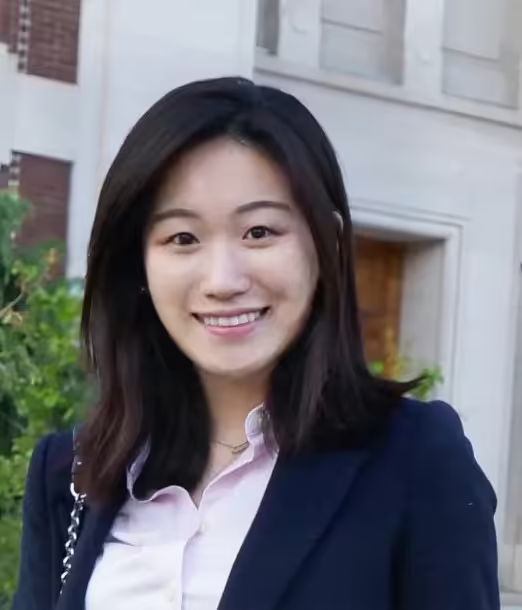
In this talk, Yelin Kim will discuss how demanding multimodal AI systems can be deployed directly onto wearable and robotic edge devices where traditional cloud-first approaches break down. Focusing on Amazon’s smart AR delivery glasses, she will share how these fully on-device wearables achieve real-time perception within a strict 5–7 W power budget and severe latency constraints.
The talk will also explore how architectural patterns from Amazon’s home robot, Astro, evolved into shared foundations for multimodal perception and edge AI processing across wearable systems.
Finally, Yelin will discuss reusable engineering and applied-science patterns for building entirely new product categories, including multimodal fusion, hardware-software co-optimization, evaluation methodology, and production learning loops under tight power, thermal, and compute constraints—along with open problems shaping the next generation of human-centered AI.
Yelin Kim is a lead scientist at Amazon's Last Mile AR Delivery Glasses project (https://www.aboutamazon.com/news/transportation/smart-glasses-amazon-delivery-drivers) in Sunnyvale, California. She directs the AI technical strategy for Amazon's last-hundred-yard delivery program built on AR smart glasses, leading a cross-organization science team spanning computer vision, SLAM/VIO, and on-device multimodal perception. Over the past decade she has bridged frontier AI research and large-scale product delivery, shipping real-time perception models onto power- and latency-constrained wearable and robotic edge devices. Before the delivery glasses, she led Edge AI and human-centered perception for Amazon's first consumer home robot, Astro, delivering breakthrough human-robot interaction features and founding its affective computing charter.
A former tenure-track professor at SUNY Albany, Yelin has authored numerous peer-reviewed publications at top conferences/journals, including a 2026 CVPR Highlight (top 2.5%) and recent ICCV/ECCV papers, and holds four granted U.S. patents in multimodal and on-device perception. Her honors include the Google Faculty Research Award and a Best Paper Award at ACM Multimedia. She earned her M.S. and Ph.D. in Electrical Engineering–Systems from the University of Michigan, and her B.S. in Electrical and Computer Engineering from Seoul National University.